
“1.4 Ten Sephiroth of Nothingness, Ten and not nine, ten and not eleven. Understand with Wisdom,
be wise with Understanding. Examine with them and probe from them.
Make each thing stand on its essence and make the creator sit on his throne.
“1.7 There are Ten Sephiroth of Nothingness:
Their end is embedded in their beginning and their beginning in their end, like a flame in a burning coal.
For the Master is singular, He has no second. And before One, what do you count?”
—- Sepher Yetzirah
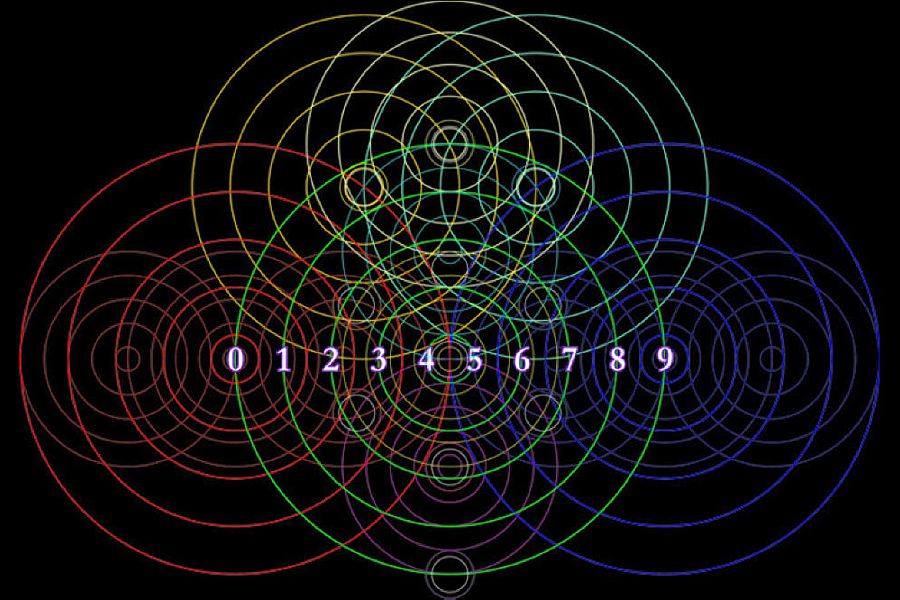
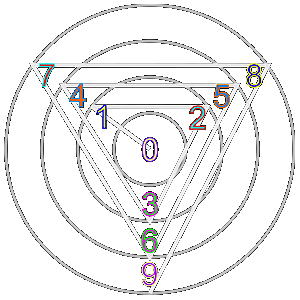
The Tree of Life Sephiroth arrangements in this interpretation use the ten characters of the Indian/Arabic Number system: 0.1.2.3.4.5.6.7.8.9, which are called the Ten Ideal Numbers. This is not to be confused with the ‘ideal numbers’ of Kummer or Dedekind’s ‘ideals’ in ‘Ring Theory’. I know that there will be considerable push back for using these ten ideal numbers instead of the numbers one thru ten. They will argue that the ancient Hebrews didn’t used their letter system to represent numbers and it didn’t have a zero. However, it did have tens and hundreds and used the base ten system, and the Kabbalah was developed at a time and in a place where the Arabic number symbols, including the zero symbol, were very much used, and the value of using the zero marker was very much understood and widely used by the Indian, Muslim, and Jewish merchants of the day.
These particular Ten numbers were chosen because of the special attention in the Sepher Yetzirah to separate the consideration of the Ten numbers being discussed from the twenty-two Letters. In the line “ten and not nine, ten and not eleven” gives a hint to the fact that it is not just a simple observation of the numbers one through ten, but of the ten Arabic/Indian Ideal numbers zero through nine. For although the ten ideal numbers culminate with the number nine, they are not just nine numbers since they begin with the non-quantitative number zero for a total of ten numerals. For although the number ten represents the first complete set of the Ten Ideals (1 signifying the first complete set of ideals and 0 the beginning of the next set), it is not to be included because it is not one of the ten single digit Ideal numbers, but rather the first double digit number, which if included would be a total of eleven numerals and not just ten. Speaking in riddles and vague references was the norm with the esoteric traditions, especially when dancing around the esoteric notions of zero and infinity. Since zero was not a thing that could be objectively described it was called a nothingness, and the ideal number spheres were called sephirah of nothingness. When they said, “Their end is embedded in their beginning and their beginning in their end” they are describing eternity; and when they said, “For the Master is singular, it has no second. And before One, what do you count?”, they are alluding to Zero without directly saying so, and they would thereby elude the mundane minded who lacked the ability to conceive of, or be trusted with, such concepts.
The emphasis on the Supreme Unity represented by the number Zero as opposed to the quantitative singularity represented by the number One, suggests to the reader that there is much more to these statements than what might be seen only with a simple materialistic view, as opposed to, a complicated ethereal view. They also suggest that if the reader sees what they are alluding to then they should keep it silent, for therein lies the great secret of the Supreme Spirit of Unity, which is undefinable and infinite, and also very powerful. This is the same idea as the Pythagorean notion of the Monad, which he said is not to be confused with the quantitative number one, where the singularity of the ultimate unity of all gives rise to the manifested singularity of one like a reflection of itself as a unified wholeness, a uni-verse.
Even the statement of “For the Master is singular, He has no second. And before One, what do you count?” may sound obvious to the quantitative thinker as referring to the number one, but to the qualitative thinker, one who is aware of the Ten Ideal Numbers of the Arabic/Indian system of ten numbers, would understand how the number zero is the only number that is uniquely different from all the other numbers. The nature of zero implies the same notion as the monad did for Plato. It implies the idea of infinity and eternity, however, because that which is non manifested cannot be defined or described in a material sense, it is only eluded too and danced around in riddles, incomprehensible to those who cannot conceive of nonmaterialistic notions. The container of all things is nothing, it is the emptiness of space which holds all mater within it. In essence zero is a position within infinity from which all measurement is dependent upon in order to establish a distance or relative value. It can also represent the relevant point of view in time and space that is neutral, neither positive nor negative, past or future, odd or even, male or female, the ultimate impartial observer, the ever present now.
The mastery of the Indian/Arabic system of numbers was well known among the Jews long before the appearance of any Kabbalistic writings. The preponderance of many western researchers on insisting that a number system without zero was being discussed in this veiled book of creation called the Sepher Yetzirah is presumptuous and completely ignores the fact that the Hebrew Kabbalah was conceived in a predominantly Islamic society, within which the Jews of the time studied, worked ,and lived with the Indian/Arabic number system which called zero a sifr (cipher). It also completely ignores an extensive history of the Jews as traders, not only within the near east, but as far east as India, where zero was well established in their arithmetic system.
Zero is the pause or space which establishes a group of letters as a word in writing; it is the silence which defines the sound; it is the source of light out of darkness; it is your birthday. Zero doesn’t change the nature of any number that it is added to or subtracted from, and it eliminates all quantitative value when it is multiplied or divided by. Yet it is the only qualifying source of the determinate value of all other numbers. In a since Zero defines all values by the common contrast of its’ relative placement as the origin point. The Pythagoreans called it the monad to clearly distinguished it as different from the quantitative one. There would be no calculus, or even any modern physics without its’ inclusion and consideration in mathematics. Zero is the ultimate Unifying Point, the neutral point between positive and negative, without which we would not be able to fully consider the notions of Time, Space & Energy. Everything has to start at some point in time and space. The time and place of beginnings is the notion of a Zero point, and the inverse of the zero point is the never-ending notion of infinity.
The Key number used within this lineup of the numbers 0-21 is 6, which is the first perfect number. Six is the common denominator of all the numbers being used in the 22 paths of the Tree of Life when reduced down to an idea number digit; that is when all the digit numbers of the paths and spheres are added together and then reduced down to a single digit. No other Ideal number will obtain this result with all the ten accumulation points (Sephiroth) equaling the same number. This is a result that can’t be achieved without the inclusion of a zero point. The numbers of the paths of this Tree of Life system are derived from the 22 numbers of the Tarot, 0 through 21, and the 10 Planets and 12 Signs of the Zodiac (10+12=22). Each number with two characters (10, 11, 12, etc…) is split between the two ends of the path so that there is only one digit per path added to the number of each Sephora the path connects to, and zero being added to one end of the path for the single digit numbers (01, 02, 03, etc…). The use of the number six as a bases for a numerical thread of continuity lead to some interesting configurations that yielded harmonious patterns that would not have been obvious otherwise. There are other patterns that can be observed using other numerical relationships and they have also yielded interesting results but non as harmonious as the use of the number six as the cornerstone to build upon.